Comparing cycling café and traditional spanish bar cafetería
Coffee stops are a strong part of cycling culture. Where we stop and what we order are parts of an identity for many cyclists. This post compares a cycling café and a traditional Spanish “bar cafetería”. I based it on my experience visiting both of these worlds in Costa Blanca, Mallorca and Tenerife. I drafted it in my head on an easy weekend ride near Calpe. I recorded a hattrick of “cycling café — cafetería — cycling café” during the ride. Enjoy!
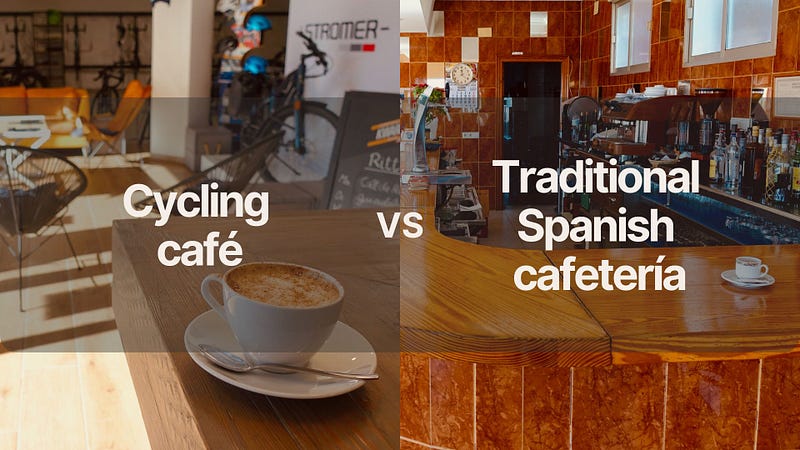
Let’s dive right into the pros and cons of choosing one or the other during a bike ride.
Coffee
The quality of the coffee beans and how the barista treats them of course differs from place to place. But the cycling cafés are more likely to serve coffee that’s considered higher quality. In some cases even what we might call “third-wave coffee”. Some even roast their beans, like Musette in Alcalali, near Calpe. This of course doesn’t have to be a rule. There are “cycling cafés” that throw a bike stand on the street, hang an old retro bike on a wall and that’s where the “specialty” ends.
In the traditional spanish bars, you don’t talk about coffee. You order “café solo”, cortado or “café con leche” and that’s it for the coffee talk. The coffee is darker, bitter and usually served very hot, so mind your tongue.
Location
Cycling cafés are right on the classic routes and are usually hard to miss. For example, there are at least 4 of them spread across a 35km route between Calpe and Coll de Rates. That’s a lot of caffeine if you stop at every one of them.
But what if you go beyond or off the limits of these classic routes? That’s when the spanish bars come to the rescue, with their presence in every little pueblo — a village.
Service and people
Again, this is unique to every place. But here I lean more towards the traditional bars, where I always find myself welcome and at ease. Spaniards tolerate people step dancing in cycling shoes and sprinkling their helmets, bidons and Garmins or Wahoos all over the table.
In contrast to the popular notion that everything in Spain takes ages, the service is usually very quick in cafeterías. Make sure you let the staff know about your presence with at least a simple “buenos días”.
When it comes to languages, knowing some basic Spanish terms in a cafetería can help. But don’t worry, you can definitely get what you want also in English. The cycling cafés are often British, Belgium or Dutch owned with multilingual staff. That makes the experience more comfortable.
Food
The food at cycling cafés tends to be richer, often with wide selection of delicious cakes. The sandwiches and the rest of the menu can also be more nourishing. It often goes beyond the traditional “tostada con tomate y aceite” or “bocadillo con jamón y queso”. Note that not all cycling cafés serve food other than the cakes.
You cannot go wrong with ordering a tostada or a bocadillo in a traditional bar. You don’t even have to look at the menu before ordering. Have intolerance or a special diet? That can be tricky.
Price
The cycling cafés in Calpe area are more expensive than the traditional bars.
Authenticity
The term “authentic” is nowadays an often misused buzzword. But I hope you agree that walking into a Spanish bar in Spain does sound authentic by nature. The same goes for sharing the same space and coffee time with fellow Spanish riders (even if you don’t talk to them!). I will get more philosophical though. The authenticity of a place doesn’t have to tie to a location or a nationality. It can tie to a community as well. The cycling cafés offer a shared sense of belonging to a community. A community of people that enjoy pushing themselves on a bicycle.
The conclusion
One thing is for sure — a coffee stop is an essential part of every ride, especially during a cycling holiday. I’d encourage you to not to limit yourself to one type of a place (let alone a single business). If visiting a traditional cafetería feels outside of your comfort zone, give it a try. Because self-improvement and discovery can be only found outside of our comfort zones.
Wherever you are, what type of place do you prefer to stop for your coffee? Something traditional or fitted to the cyclists?